
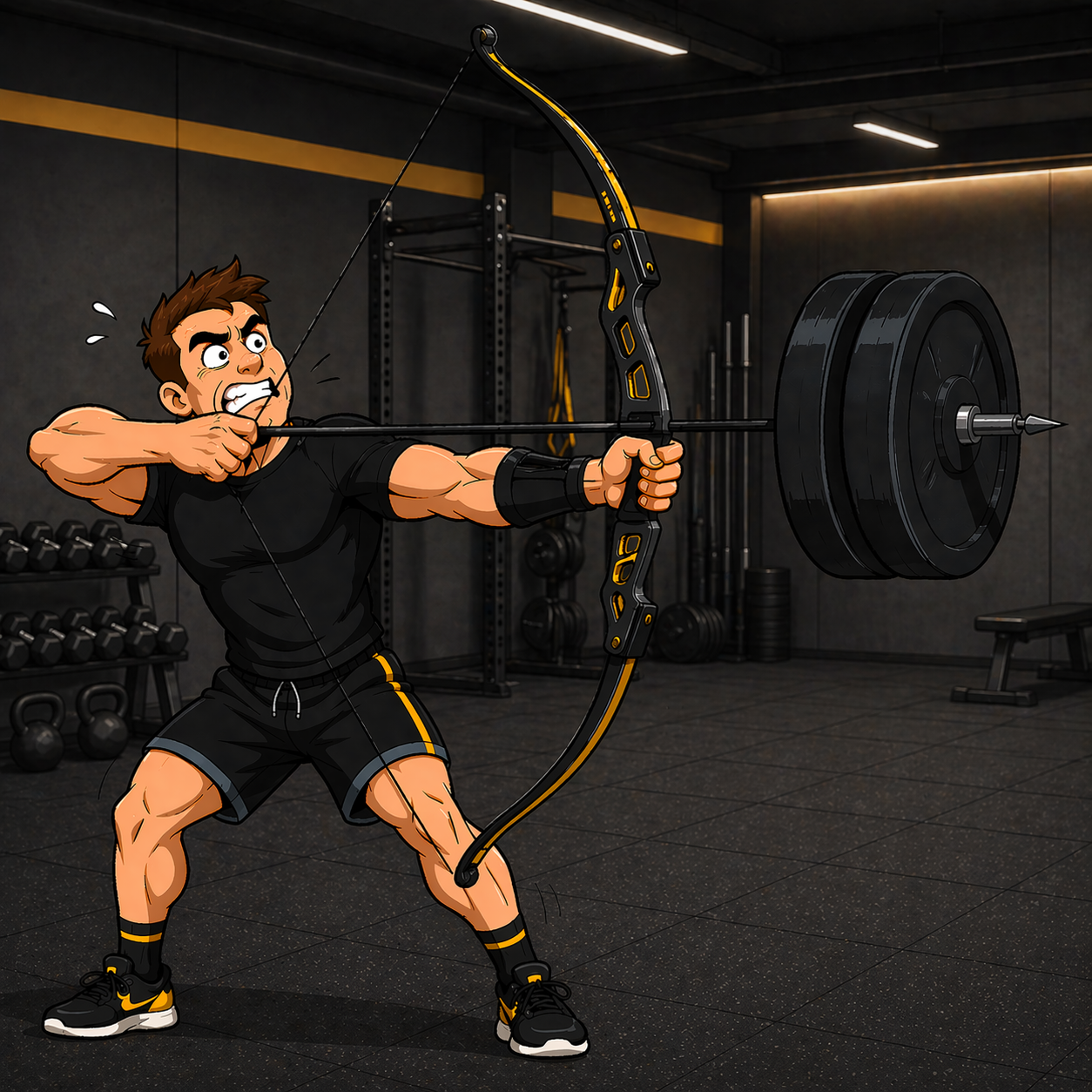
Conditioning for archery is often put on the backburner, like it is for many skill-based sports. When it comes up, it usually revolves around shoulder exercises, posture work, and general strength. Taking a closer look at the demands of the sports allows us to structure intensity and progression in a way that supports performance while respecting the reality of athletes whose priority isn’t in the gym.
What happens during a shot
At a basic level, archery requires you to:
- reach a stable position
- hold that position
- repeat it consistently over time
We don’t really need explosive power or maximal strength. What matters is control under tension, repeated over and over again.
The limiting factors
Once we look at the sport this way, key constraints stand out:
- the ability to hold the draw position steadily
- the ability to resist fatigue over multiple shots
- the ability to maintain posture and alignment
This shifts the focus of training.
Instead of asking:
“How do we get stronger for archery?”
The question becomes:
“How do we stay stable and consistent under fatigue?”
And now it’s (even more) interesting.
Translate that into training
1. Isometric work becomes a priority
The draw phase is largely isometric.
So the program includes:
- holds in draw-like positions
- progressive increases in hold duration
- work under fatigue
This is the closest transfer you can get from the gym to the sport.
2. Strength supports, it doesn’t dominate
Strength is still important, but not for its own sake.
It helps by:
- making each shot feel easier
- reducing relative effort
- delaying fatigue
Strength work is included, but not treated as the main focus.
3. Both arms matter… and more
Archery is not just a pulling action.
There is:
- a draw arm pulling
- a front arm stabilizing against the force
- a kinetic chain that needs to be stable
So the program trains:
- pulling stability
- force acceptance and control
- lower body and core capacity
4. Fatigue is part of the design
Performance in archery often drops late in sessions.
So training includes:
- repeated holds
- intermittent efforts
- controlled fatigue
Not just strength in isolation, but performance under fatigue.
Building a progression
We’re now ready to dive-in. We understand the needs, and we know the common constraints:
- S&C is not exactly a priority
- Equipment and time are limited
- Gym knowledge might not be peak
We want something easy to understand, easy to perform, with transferability that immediately clicks:
I can do that by myself, I understand why and how it works.
In this intro program, we’ll have three phases that will serve their own purpose: control, strength, and endurance.
Phase 1 – Control, 4 weeks
Feel in touch with your body, understand how it moves and how it translates to archery.
- Learn positions
- Build coordination
- Low fatigue
Phase 2 – Strength, 4 weeks
Observe a progression in strength and control, feel more powerful.
- Increase capacity
- Longer holds
- More load
Phase 3 – Endurance, 4 weeks
Work on a direct parallel between gym time and bow practice.
- Repeat efforts under fatigue
- Maintain control over time
- Simulate real shooting demands
Each phase feeds off the previous one. Structured sessions and a clear progression translate directly to an improvement. This approach is not about doing more, it’s about doing what matters for the sport: if training reflects the demands of archery, it doesn’t need to be complicated.
Want to try it?
If you’re curious how this looks in practice:
👉 Below are the first 4 weeks of this program. You can download it and start immediately, for free.
If you want the full version
The complete 12-week program includes:
- full progression across all phases
- detailed structure
- the full system behind the plan
Available here:
👉 Performance training for Archery – 12 weeks
For both these programs, you’ll need very little equipment and a basic understanding of what Reps in Reserve are, you can learn more here and contact us if you need to!
If you’d like to experience how this approach can work for you, reach out or schedule a discovery call.
More topics

May. 2026
Aug. 2025